Sunday, October 30, 2016

You can't fault people for disobeying a rule you just invented

It seems that some people follow this process when they see behavior they dislike:

  1. Think up a rule that disallows the behavior.
  2. Assert the existence of that rule.
  3. Chastise the people engaging in the behavior for violating the rule.
On Stack Exchange, some behaviors people sometimes complain about are downvoting posts without a comment and closing older questions as duplicates of newer ones. (There are plenty more, of course.)

Relevant Old New Thing article: Sometimes people don't like it when you enforce a standard. The last paragraph is the best part.

To be fair, sometimes the real rules are bad and should be changed. It's happened before. But declaring that reality is other than of how it really is does nothing other than display the complainer's ignorance. And indeed, such SE comments usually earn their poster a link to the relevant help center page or meta post.

Instead of denying reality, people who feel wronged by the system should do something like this:
  1. Go look up the relevant rules to see who is mistaken.
  2. Try to figure out reasons for the rules being how they are.
  3. If desired, explain why you believe the rules should be changed.
  4. Post your ideas for discussion.
That way, if your ideas do make sense, you stand a good chance of correcting the problem as opposed to just stirring up annoyance.

Oh, and if you're curious, the two behaviors mentioned above have been constructively discussed on Meta Stack Exchange:

Monday, October 3, 2016

Student Hunger Drive Kickoff 2016

The Quad Cities Student Hunger Drive (a six-week-long food drive from area high schools) kicked off tonight with the annual skit competition. As usual, my school performed a choreographed dance involving box movements to a parody of some song or another. After all nine entrants to the skit competition did their performances, there was - like last year - a tie, and it was the same tie as last year: us and a certain other school.

So both schools redid their respective skits. The tie was again to be broken by which skit received louder cheering. To be honest, I wasn't super optimistic: we lost last year because the competing school had brought a boatload of people to cheer. To my very happy surprise, two non-tied schools started cheering for us, quite loudly, and the referee announced that we won! That's two thousand pounds of food donated by Hy-Vee on behalf of us, giving us a good head start in the competition soon to come.

Tuesday, September 6, 2016

Don't blindly trust the TLD

I have seen two sources now suggesting that information on web sites that end with .gov, .edu, or .org is likely to be trustworthy. Those first two are virtually always legit - you have to actually prove yourself as an appropriate type of entity (US government department or higher education institution,respectively) to register them. .org web sites, on the other hand, can be registered by absolutely anyone, for a few dollars per year. For instance, see this satirical warning website about dihydrogen monoxide (water). They even have a DMOZ organization title in Google search results.

Even .edu web sites frequently have "home folders" where teachers and sometimes students can host static content of their choosing. Though the people writing that content are certainly very smart, the work isn't likely to be peer-reviewed.

Basically, looking at the web site's top-level domain isn't enough to verify the trustworthiness of an arbitrary document under it. More importantly, please don't spread the overgeneralization that all .org web sites are high-quality.

Friday, August 12, 2016

House on the Rock and Cave of the Mounds

Yesterday, my father and I drove up to Wisconsin to visit two attractions: the House on the Rock and Cave of the Mounds.

We first went to House on the Rock. It starts with a room containing information panels and videos about the history of the House and its creator. There is then a winding wooden path through the forest up onto the rock. The first section (the original construction) is composed of paths and stairs that navigate around outcroppings and trees. Along the walls, there are bookshelves, cooking implements, and Asian-like items. This section also has access to the Infinity Room, which overhangs the forest.


Along the way, several seating areas are visible but cordoned off. Through them, other parts of the path can be seen. It seems that the barriers could be rearranged to produce a different path through the rooms. There are one or two music-making machines around. Outside the house, there are lookouts toward the forest.


The second section is much larger. It starts with the "Streets of Yesterday" exhibit, which has arrangements of 19th-century buildings, like households, dentist offices, and shops. Those buildings have many interesting artifacts corresponding to their function. At the end of that entry hall is a massive music machine: the Gladiator.


The path then goes into a huge sea-themed area. There is an "octopus garden" statue/sculpture to the right, and the center of the very tall room is taken up by a statue of a whale-vs.-octopus battle. Along the walls are nautical artifacts and history on famous ships.


Past that, there are some interesting cars, like one completely covered in tiles. Nearby, there's a café, at which we got some pizza. Continuing on into "The Music of Yesterday", there are more automated music rooms.


The third section features a massive carousel, with all kinds of creatures. Several smaller carousels can be seen from later paths.


The path then enters another large area, this time full of unlabeled inert machinery. The color scheme here is really interesting: mostly gray from the metals, with some red splashed in from small displays reminiscent of the second section.


After the machine room, there's another relaxing break spot. The path then continues by some medieval-themed display cases and into a circus-themed area. There is a section with dolls and dollhouses, then the room opens up and the ramp circles another circus music machine. After a trip by the small carousels, visitors exit onto an outdoor path back toward the entry building.


We drove the half-hour or so to Cave of the Mounds and registered for an hourly cave tour. The first thing I noticed is that the climate is really nice inside the cave: cool and not humid. Most of the cave is very easy to navigate - there are high ceilings and fairly wide paths - while one part in particular is very narrow and short.


The cave has impressive formations, and also a small, beautiful river.


On the drive back home, we stopped at an A&W for a burger and root beer.


Friday, August 5, 2016

Visiting Chicago

Yesterday, my father and I visited Chicago, primarily to see the Museum of Science and Industry. Since we had all day, we got tickets for general admission and three timed-entry events.

Before the first such event started, we went to find the Omnimax theater so we would know where to go later. (The Museum is a big place!) While around there, we saw an exhibit on the history of the space program. There was a dramatic video about the moon landing, which was interesting because I didn't previously know about the issues encountered on the way down.


The first scheduled event was a tour of the captured German U-505 submarine. The entrance hall to the main room told of how the American military planned to capture a German sub rather than just sink it. That was an amazing feat, especially considering that the sub was continuing to sink as the Americans boarded and secured it. Its inside is very cramped, even after some objects were removed to make entrances for museum visitors.


We then went to look at the DARPA exhibit, which had a wall for the history of interesting modern technologies started there. In the rest of the room, videos and captioned pictures illustrated real-world applications for DARPA's research.


We then stopped by the food court for noodle bowls, which were delicious.

Continuing to explore the central area of the main floor, we walked through a section on genetics, which mentioned some applications of genetic engineering in dealing with genetic disorders.

In the Omnimax theater, we saw National Parks Adventure, which had absolutely amazing scenes of natural wonders. It followed the experiences of a small group of people taking trips to America's national parks. The movie also had a brief history of the national parks' conception (Theodore Roosevelt's trip with John Muir).

After the movie, we looked through "Fast Forward", a hall of ideas currently in development that have the potential to hugely impact life.


It was then time for the last timed-entry event: Future Energy Chicago, which had been described as a simulator for energy conservation strategies in a city. It consisted of five semi-competitive games. It seemed to be targeted at a younger age group, but with the competition it was still a good time. One of the games was about installing various kinds of public transportation to remove cars from the road, and the tutorial included the direction "Drag a train onto a busy road." At the end, my father and I won (which makes sense considering the age of the other players), but the scoreboard also included a "combined team" score, which was the average of the high scores from each game, and so was of course higher than any individual team's score. The moral of the story is that collaboration is key, see. (An individualistic game designer might rig the combined score as the minimum of the individual scores to reflect the more likely scenario that one poor performer holds everyone back.)

There were still several exhibits to see. We looked at a John Deere farming technology exhibit, saw a classic coal-powered train, went in a real decommissioned Boeing 727, checked out a sound reflecting room, and went through a mirror maze.


By this time, the museum was about to close. Back in the lobby, we looked at and heard the story of the Pioneer Zephyr, the first "streamlined" train.


Exiting the museum, we started driving toward the Willis Tower, but stopped on the way at the Berghoff's (a German restaurant) for dinner. We shared a plate that included several things served by the restaurant and finished out the meal with apple strudel.


That one plate was more than enough for both of us. It was very good, as was the root beer.


We then walked over to the Willis Tower and went up to the Skydeck.


After all that, we started the several-hour drive back home. It was definitely a very full day.

Saturday, July 16, 2016

The Lab, day 3

While looking around town in West Covina, CA yesterday, I saw this:

Hope you're not in a rush!
Anyway, today was the third and final day of Reasons To Believe's "The Lab" conference. Before arriving at the RTB office, my father and I went to Flappy Jack's Pancake House on Route 66. The plates of pancakes have an absolutely massive amount of food; I had to box more than half of my banana nut pancakes. Those, and their Hawaiian ones, are delicious.

A street sign for Route 66
The conference's day opened with advice on college life: being intentional about time. After that, we got into some more interactive apologetics training. We considered challenges from headlines/excerpts of scientific news, developing responses from both science and theology.

There was then an amazing talk about how environment affects cell behavior, i.e. how genes don't determine everything. It also covered some ways that the raw base pairs are controlled and interpreted, like packing and separators.

One of the conference's most impactful talks was on a four-part argument for design. That argument first needs to critique the evolutionary model, which is most effectively done by considering whether the model's predictions are fulfilled. Three positive arguments for design can then be applied. There are the "watchmaker" argument (design requires a designer), the empirical argument (humans built some life, but only with great intelligence and modern tooling), and the bio-inspiration argument (humans are making technological gains by examining nature's mechanisms).

After the conference ended with commissioning, we said our goodbyes to all the other attendees and speakers. My father and I will be flying back home tomorrow morning.

Friday, July 15, 2016

The Lab, day 2

Today was the second day of Reasons To Believe's "The Lab" conference in West Covina, California.

Me with the RTB sign
In the morning, the presenters reviewed the three major destinations on the science-faith landscape: young-earth creationism, old-earth creationism, and evolutionism. It lined up the six "days" of creation with biological events, noting how impressive it is that the author of Genesis managed to get the order right despite how a human living in that time might expect the world to be built.

We then all loaded up the vans and went to the Griffith Observatory for their "Center of the Universe" planetarium show. The observatory has a lovely campus. It's up on a hill with trails leading up to the actual building. From there, the Hollywood sign is visible.

With the Hollywood sign in the background
Outside the building, there was a noon detector:

"It's high noon..."
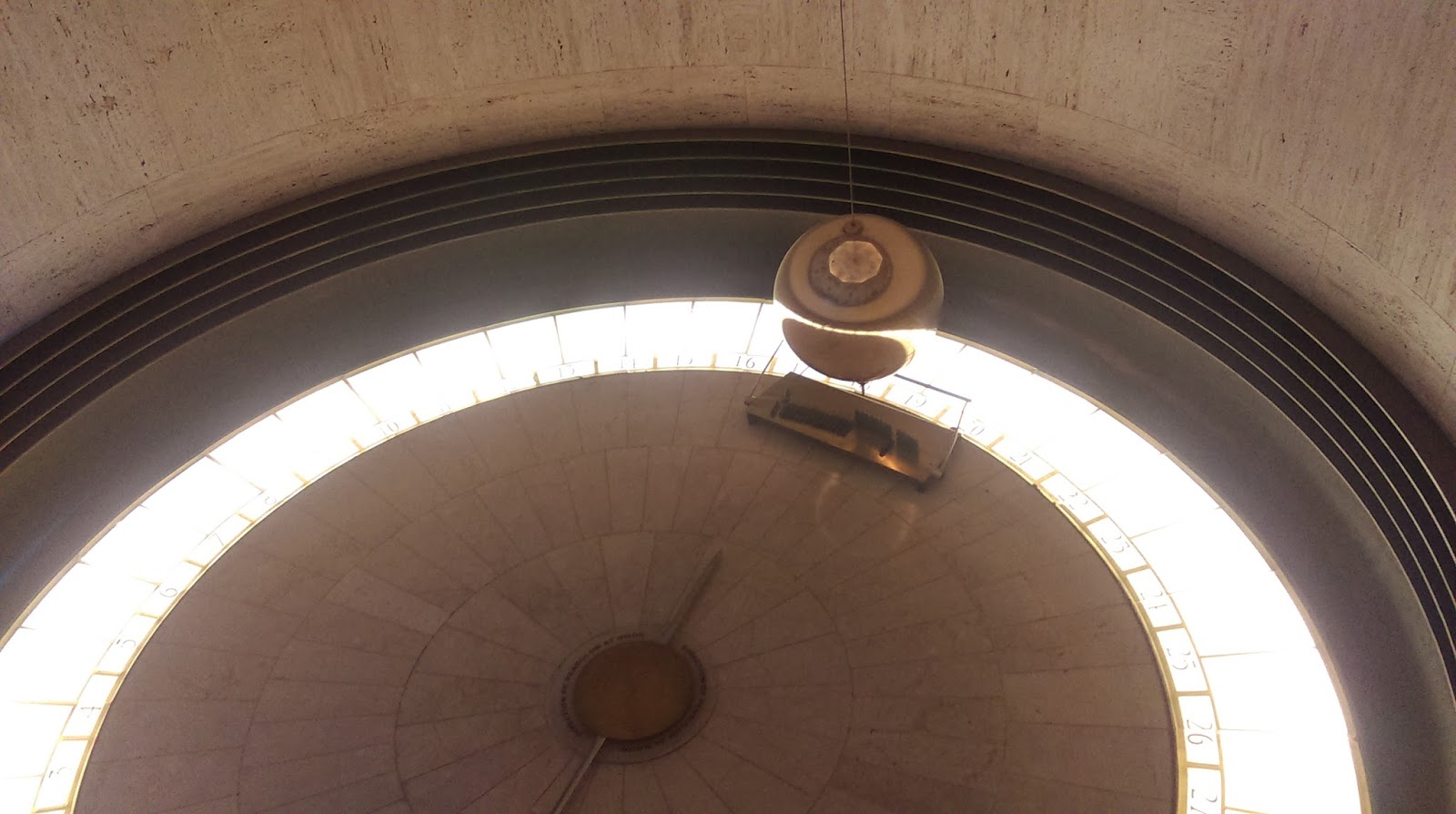
Inside, there was (among many other interesting exhibits) one of those devices that prove that the Earth rotates:

A swinging pendulum that knocks over pins as the day progresses
During the show itself, I was impressed by the quality of the animation. The narration was soothing yet interesting. The show covered humanity's exploration of the universe and how our understanding of the cosmos developed.

Once we arrived back, there was a session about the relationships between the numerous species of life. The presentation contrasted common design with common descent. It showed the difficulties involved in building a tree of genetic development that links all life.

We ended the day hearing about how to effectively engage in dialogue with those who may not be entirely receptive. This presentation was also notable for its use of webcomics (especially XKCD and Ph.D. Comics, which are both amazing).

The silhouette of the mountains at night